
Arlington City Directory Shelves
Arlington's historical directories are a set of overlapping runs, not a single continuous database. The County historic-property research material identifies Nelson's Directories, Hill's Alexandria Directories, Hill's and R.L. Polk volumes, and Haines Arlington volumes. Washingtoniana holds the Nelson's and Hill's Alexandria runs. The Charlie Clark Center for Local History, commonly called CCCLH, holds the Hill's, Polk, Haines, old county, telephone, and real-estate materials. Confirm the catalog and a desired volume before making a special trip.
| Collection | Years | Where held | Access |
|---|---|---|---|
| Nelson's Directories | 1912-1931 | Martin Luther King Library, Washingtoniana Division | Onsite review; verify the individual volume |
| Hill's Alexandria Directories | 1938-1955 | Washingtoniana Division | Onsite review; includes Arlington-area material |
| Hill's and R.L. Polk directories | 1924-1976 | Charlie Clark Center for Local History | Public research-room use by appointment |
| Haines Arlington Directories | 1976-1990 | Charlie Clark Center for Local History | By appointment; confirm the volume run |
| County and telephone directories | Various | CCCLH reference collection | Reading-room research |
Start with the year closest to a known birth, death, move, or deed. Then test neighboring years. A gap can reflect a missing local run, a catalog issue, or a household that the publisher did not include. It does not establish that the person had left Arlington County.
- 1912: Nelson's Directories begins the earliest documented local run.
- 1924: The Hill's and R.L. Polk run begins at CCCLH.
- 1938: Hill's Alexandria Directories begins at Washingtoniana.
- 1976: Haines Arlington Directories begins; its documented run ends in 1990.
Arlington Directory Reference Room
The CCCLH reference collection brings directories together with census microfilm, local court material, family histories, maps, photographs, oral histories, and Sanborn maps. The Center is on the first floor of Central Library at 1015 N Quincy Street. Published research-room hours are Tuesday 1-5 p.m., Wednesday 10 a.m.-5 p.m., and Thursday 10 a.m.-2 p.m., with additional appointment hours. The desk number is 703-228-5966.
See the CCCLH directory and reference listing before planning an Arlington city directory visit.
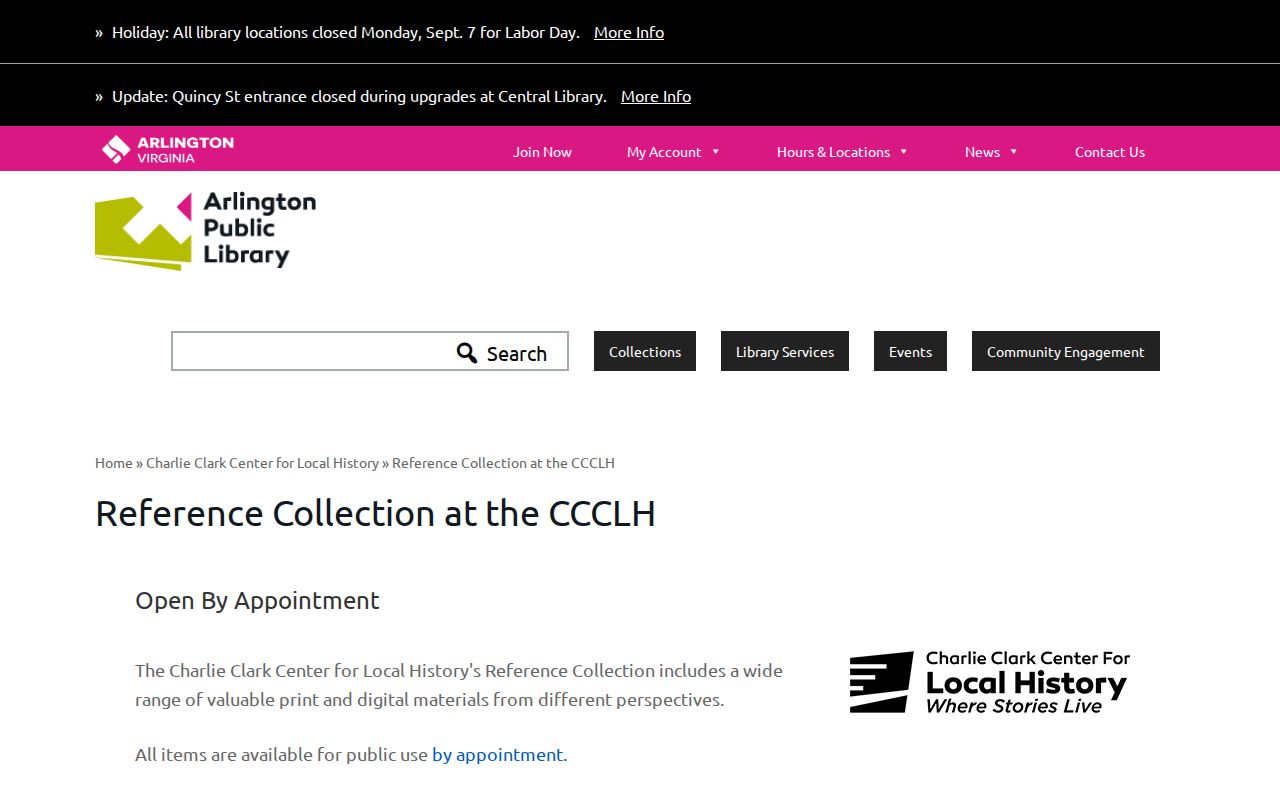
The collection page identifies the nearby sources that can settle a doubtful name, address, or date after a directory search. Reference and rare materials stay in the reading room, so the useful preparation is a list of names, dates, and address forms to compare at the table.
Read an Arlington City Directory Entry
County guidance describes city and county directories as phone-book-like records that often add an occupation and spouse's name. Some volumes also include a street section that orders entries by road and number. The locally documented sources do not reproduce a complete Arlington entry or a universal abbreviation key. Read the introductory key in the specific volume instead of carrying an abbreviation meaning from a different publisher.
| Name line | Compare surname, given name, middle initial, suffix, and any alternate spelling. |
|---|---|
| Relationship clue | Note a spouse in parentheses, a “Mrs.” notation, or a widow notation only as printed. |
| Occupation | Use it with the street and name to separate two people who share a surname. |
| Residence | Copy the street number, directional prefix, suffix, and any unit or boarding notation exactly. |
| Street section | When present, compare the address-order listing with the alphabetical listing. |
- Street section
- The address-order portion of a directory, if the volume includes one. It can place an entry among nearby street numbers.
- Alphabetical entry
- The surname-order listing used to locate a person before checking an address or related names.
- Abbreviation key
- The publisher's explanation of shortened labels, normally found in the volume itself. Its meaning must be confirmed there.
Do not treat a directory entry as a complete household roster. An owner can be absent while another person at the address appears, and a person can be omitted from one volume while present in the next. The entry is strongest when its street, relationship clue, and time period agree with another record.
Arlington Directory Names Before 1920
Historical catalog work requires three jurisdiction names. Library of Virginia material identifies Alexandria County, Virginia for 1789-1801, Alexandria County, District of Columbia for 1801-1846, and Alexandria County, Virginia again for 1846-1920. The County became Arlington County in 1920. A family tied to the same ground can therefore appear under a different county label in a catalog, census, deed index, or directory.
The Library of Virginia Arlington County microfilm catalog is the place to check those historical names and its deed-book listings. It also helps bridge an old directory address to a recorded legal description when the street name is unclear.
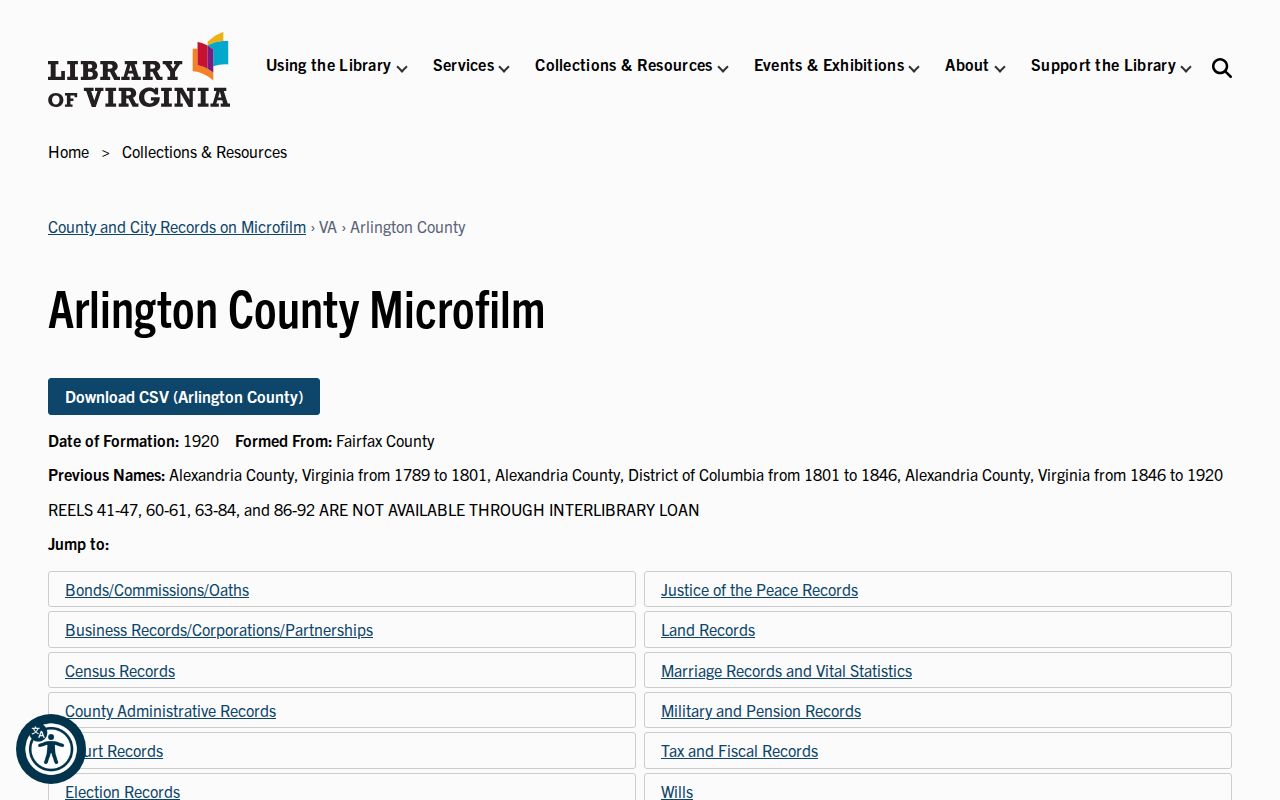
The catalog's historical-name sequence prevents a false dead end. It also shows why a result labeled Alexandria County can still be the correct trail for an Arlington family.
Arlington City Directories and 1920
Directory years fit especially well beside Arlington's local 1920 census project. The library project provides direct data, detailed datasheets, and surname rankings for five enumeration districts in present-day Arlington's historic area. It used death certificates, World War I enlistment forms, and 1910 and 1930 census data where the 1920 schedule was missing or hard to read. That makes a directory entry more useful than a name alone.
Use a city directory year to identify an address and any stated occupation or spouse, then compare it to the census household. A newspaper item, probate file, or deed can test whether an apparent move was a move, a renumbering, or a different person with the same name. The Center for Local History holds the local census and map material needed for that comparison.
Can a person disappear from a directory without leaving Arlington? Yes. Coverage, publisher choices, spelling, and an altered address can all change the result. Check the adjacent volume and the street section before treating an absence as proof.
Arlington Directories Beyond Addresses
The Arlington Historical Society family-history resources point researchers to the library's local-history collections, Library of Virginia directories, and school material. CCCLH has about 350 Arlington County school yearbooks, many digitized and some available only in person. Yearbooks can corroborate a school-era name, while newspaper clippings, oral histories, and organization files can add a date or community connection that a directory omits.
Open the Historical Society's Arlington family-research route when an Arlington city directory search needs a companion collection.
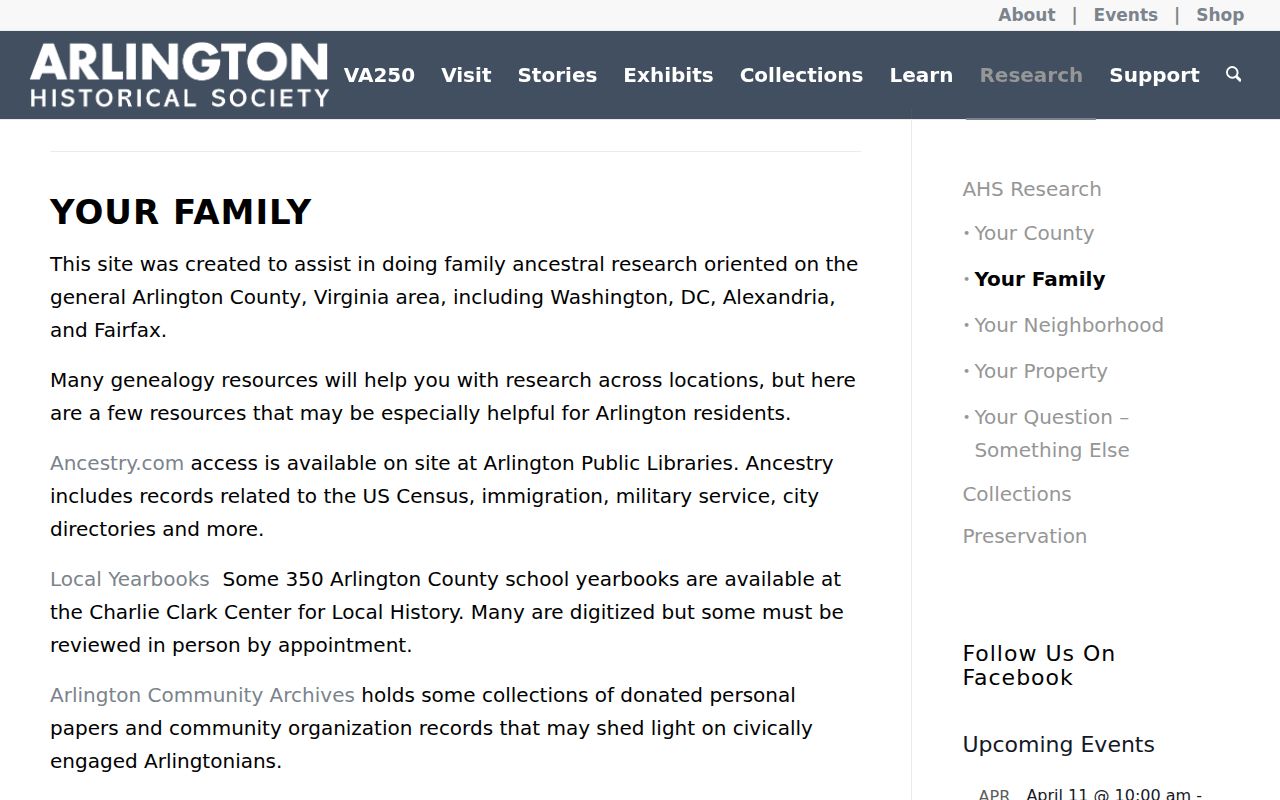
These resources add context without changing what the directory proves. A yearbook or clipping may support a date, school, or organization connection, but the original item should be cited and read in full.
Arlington Directory Archive Requests
The Arlington Community Archives contains personal papers, organizational records, photographs, and related material, but the Carrie Johnson Archival Center is off-site and closed to the public. Search the online finding aids first. A request should identify the collection, box, series, file number, and title when known. The archives ask researchers to allow a week for retrieval and notify them within seven business days.
Use the archival-material request form after identifying a likely collection. That process is more reliable than arriving with only a surname, particularly when an Arlington directory points toward a club, neighborhood group, or family paper.
Arlington City Directory Address Changes
The 1935 directory of street names is essential when an old street number fails to line up with a current address. County historical material says a new street-name system was adopted in 1934 and original street names and numbers changed in 1935. A reader can otherwise follow the right family into the wrong location, or miss the correct entry because a familiar road name did not yet exist.
Start with the historical street form, then compare the successor form in adjacent directories and maps. For a modern parcel or recorded description, use the County's historic-property research method. Current address-keyed records belong to the Arlington Street Directory, where parcel and deed research are handled in detail.
County historic-property sources also point to a 1900 property-owner map, Franklin Survey Company atlases from 1930-1942, 1942-1948, and 1952-1965, plus historic aerial photographs from 1934-1989. Those sources establish lot and building context, not the people connected to a directory entry.
Note: The street conversion and the 1920 county-name change can occur together in a family trail, so preserve every original spelling and address form.
Trace Families Through Arlington Directories
A careful Arlington city directory trail moves one volume at a time. It keeps the record at each step, rather than turning a name match into a claim about a person's life. Pair each directory line with a date and address, then use the closest census, deed, probate, or newspaper source to test the connection. When a historical result needs present-day confirmation, the Arlington Resident Lookup provides the separate official-record workflow.
- Choose the volume nearest the known event and copy the entry exactly, including the address and printed abbreviations.
- Check the alphabetical listing and the street section if that volume has one.
- Move backward and forward through the available run, recording each name, spouse clue, occupation, and address change.
- Compare the timeline with census material, a deed's legal description, or a probate filing.
- Use yearbooks, newspapers, oral histories, and archive finding aids to test a school or community connection.
The result is a dated research trail, not a substitute for the source document. It is most dependable when independent Arlington records agree on the same person, place, and period.