
Finding Arlington County Residents
Arlington County handles city and county work alike. One local government does both jobs, so there is no separate city clerk or municipal court to search. So begin with the fact you already hold. An address belongs in Arlington Property Search and AC Maps first. A name pulled from a deed, probate matter, or court docket needs a second record that agrees on locality, date, legal description, or relationship. A current owner is not always a current occupant. Old directory entries are dated clues. The strongest Arlington residents directory trail is a chain of small confirmations. Write down the parcel's RPC. Keep the legal description, map book and page, and the exact spelling each record used. Those details outlast an address when a unit number changes, a property sits in a trust, or an old volume carries an earlier street name. County public information describes people tied to a record. It is not a list of every household member.
- Search the address in Arlington Property Search and record the situs address, owner, mailing address, RPC, and legal description.
- Open AC Maps to compare the parcel with street, ZIP, precinct, and civic-association layers.
- Use the recorded owner or deed identifier in the Circuit Court land-record index, then match the legal description before accepting a transfer.
- For a named person, compare any public court or probate lead with the correct clerk file and its access rules.
- For a past household, consult the Charlie Clark Center for Local History’s directory, census, newspaper, and map collections.
Arlington Records Offices for Residents
Four Arlington County offices anchor any residents directory search. Real Estate Assessments ties each parcel to tax-roll ownership. The Circuit Court keeps recorded land documents and probate files. The elections office administers voter material under Title 24.2. The Charlie Clark Center preserves the local sources that matter most once a search reaches back decades. Each office answers a narrower question than the word resident suggests. Use the office holding the original record. Assessment staff can fix a parcel-card error. Circuit Court divisions each handle their own land, civil, criminal, and probate files. Old telephone, real-estate, and county directories live at the local-history center. Street-by-street parcel work belongs in the Arlington Street Directory, where the address chain gets full depth.
Circuit Court Land Records
1425 N Courthouse Rd., Suite 6200
Arlington, VA 22201
703-228-4369
Real Estate Assessments
Arlington County Government Center
Arlington, VA
703-228-3920
Voter Registration and Elections
2100 Clarendon Blvd., Room 320
Arlington, VA
703-228-3456
Arlington Parcel Records First
Arlington Property Search is the first official stop. Its results can show an RPC or parcel identifier, situs address, recorded owner, legal description, mailing address, class, zoning, map book and page, assessment history, sales, permits, and stormwater information. The County updates its data nightly. Even so, document-processing delays can leave a gap between a recorded change and what the card shows, so treat the tool as a parcel and assessment source rather than a household roster. The key split is situs versus mailing address. Situs identifies the physical parcel. The mailing address is where the tax office sends the owner's correspondence. An owner can be a company, a trust, or a person who gets mail elsewhere. Mailing and living are different things. That is why the legal description and RPC make a sturdier bridge to a deed, a permit file, or a historic map. The Arlington Property Search landing screen anchors this Arlington residents directory source. It is the public entry point.
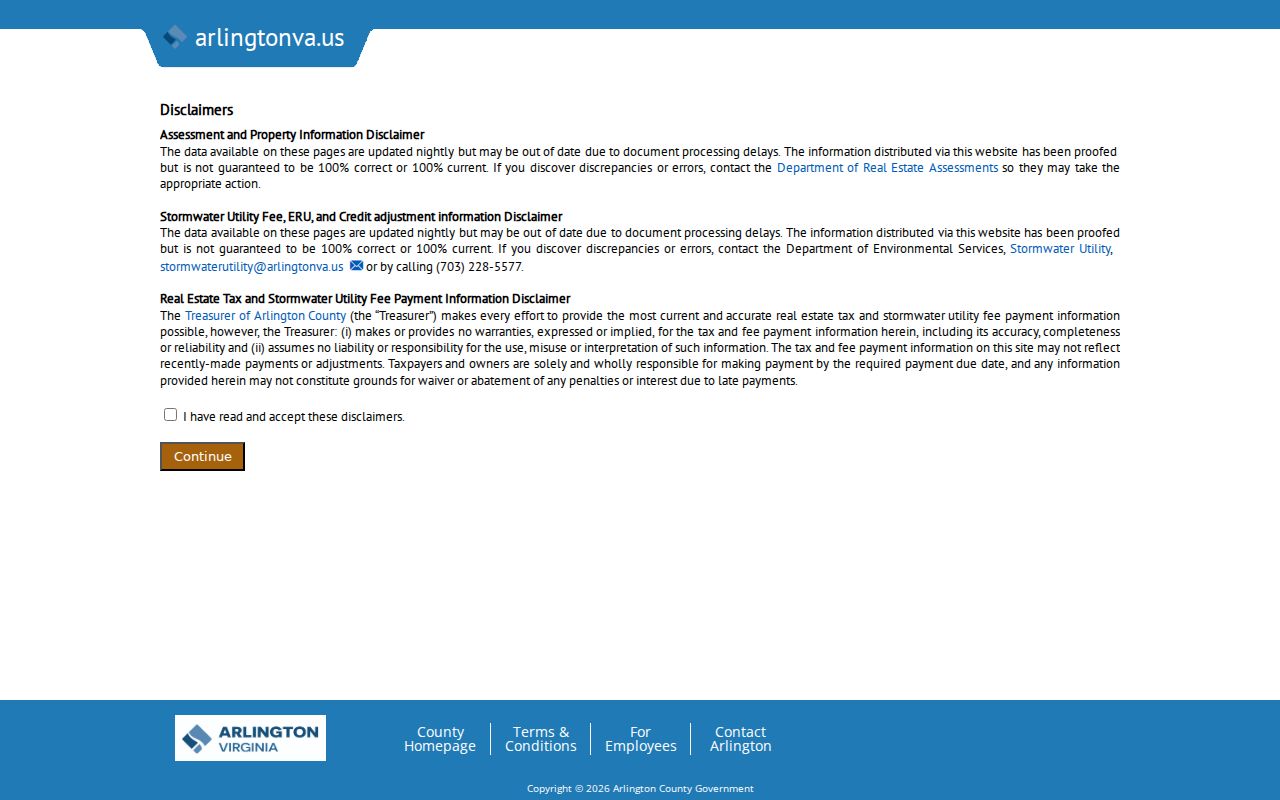
Capture the parcel keys from the address result first. Then follow the person or property into any other record system with those identifiers in hand.
- Parcel or RPC
- The County’s identifier for a real-property record, used to keep one assessment record distinct from another.
- Situs address
- The physical address attached to the parcel for assessment and map purposes.
- Legal description
- The lot, subdivision, unit, or other title description used to match recorded instruments.
- Index
- A finding tool that points to a record. It is not always the record image itself.
Note: A property result names a recorded owner and tax mailing contact, but it does not establish every person who lives at the address.
Arlington Voter Access Has Limits
Virginia's Citizen Portal serves one voter at a time. It exists for a voter checking that voter's own registration. The form asks for first and last name, full date of birth, the last four digits of a Social Security number, locality, and a certification step. It can return registration status, polling place, districts, absentee status, and voting history for that individual. The portal is not a public name-and-address directory. A nonmatch belongs with Arlington's general registrar, not with a guess about the person's residence. Virginia law separately controls public voter lists. The statutory list can carry a name, address, year of birth, gender, and districts. Protected addresses and more sensitive fields are excluded. Complete VERIS records are not open through VFOIA. Address-confidentiality participants and eligible protected voters may appear with a post-office box instead of a residence address. A missing home address is therefore not evidence that a person is absent from Arlington. The Virginia Citizen Portal page shows the registration-status route. It serves individual voters in Arlington County.
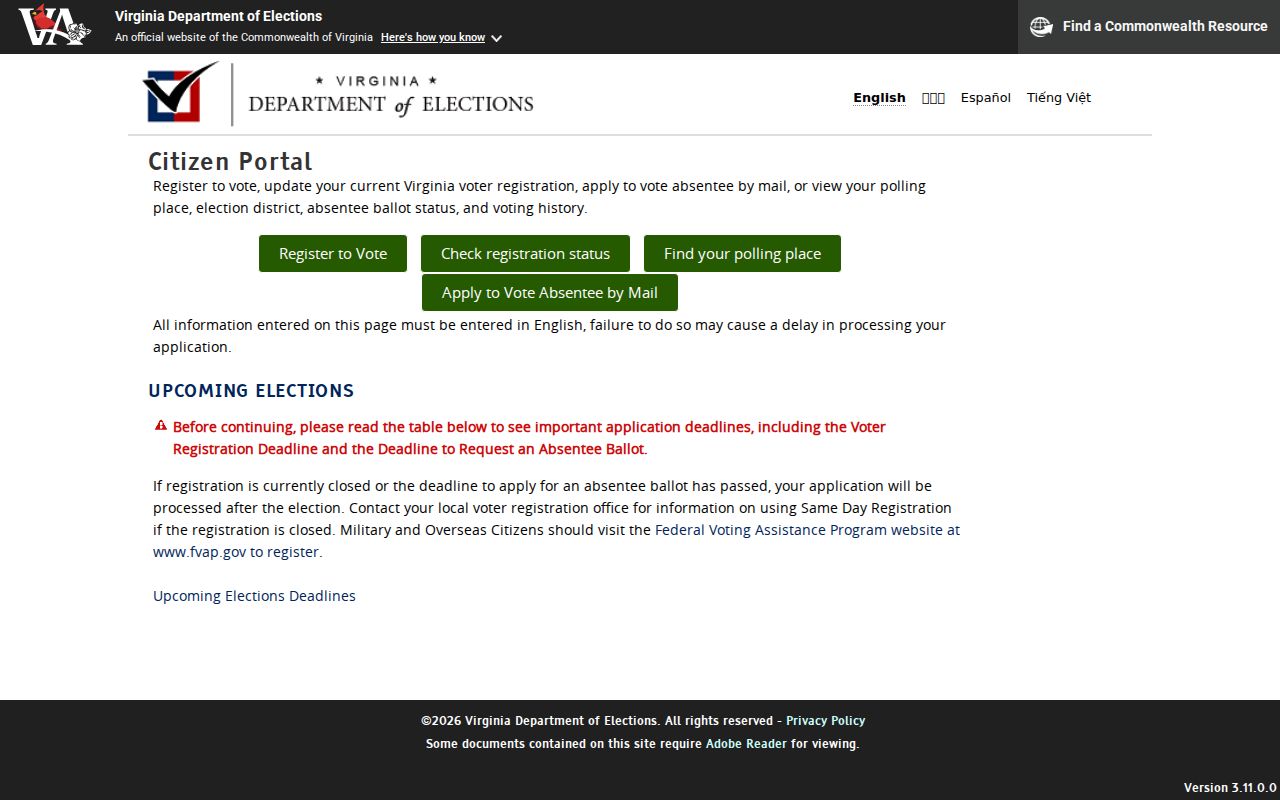
Those identity fields explain the design. The portal verifies a person; it does not browse a public residents list.
Current Arlington Resident Directories
No single roll names every Arlington County resident. A parcel card names a recorded owner and tax mailing contact. A deed index lists parties to a recorded transaction. Court and probate records identify people tied to a case or estate. Community listings name organizations, not members. Match the source to the question and preserve the date and limits that came with it.
| Arlington source | Person connection | Keeper | Access route |
|---|---|---|---|
| Property card | Recorded owner, tax mailing address, situs parcel | Real Estate Assessments | Public web result and department correction contact |
| Recorded land index | Grantors, grantees, and other document parties | Circuit Court Land Records | Registered index, kiosk, limited mail copies |
| Statutory voter material | Controlled registration-list fields | Registrar and Department of Elections | Title 24.2 inspection and request rules |
| Probate file | Decedent, fiduciary, heirs or legatees in filed material | Circuit Court Probate | STARR, kiosk, counter, or appointment |
| Community listings | Organization and public contact information | County community programs | County directory and civic-association map |
A parcel match makes a strong connection. An Arlington residents directory result is still just a lead. It is not a claim about an entire household. Tax rolls, voter material, and court records each capture a different population. Each one updates under its own rules. Occupancy is a separate question. Note: Record the grantor, grantee, document date, legal description, and book or document identifier before moving to another link in the chain.
| Official record route | Commercial lookup category |
|---|---|
| Identifies the custodian, record date, and access rule for a specific public record. | May combine marketing and public data, which can mix same-name people or retain old addresses. |
| Lets a researcher check the underlying parcel, docket, or document. | Does not replace confirmation with the original County or state record. |
Arlington Deed Records Since 1869
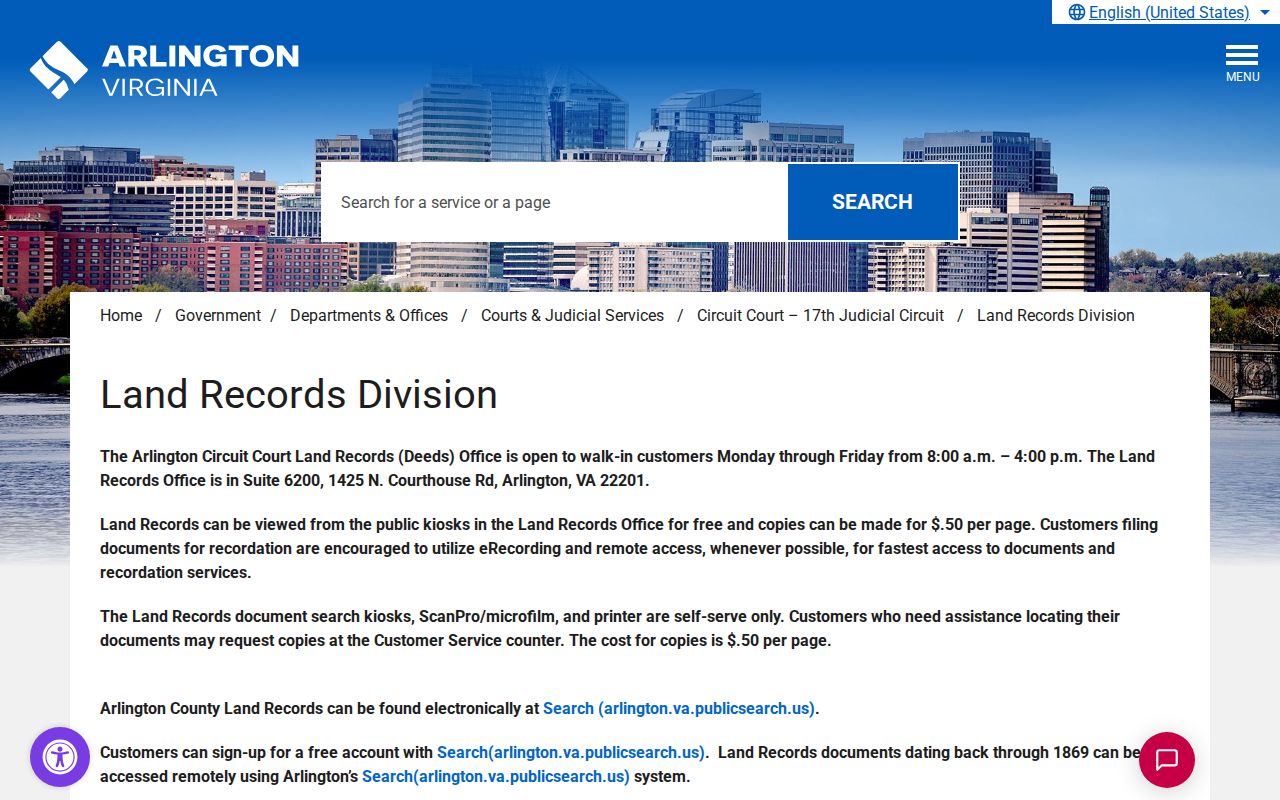
Deeds give any Arlington residents directory search its most durable link, because a recorded document ties a name to a parcel on a fixed date. The County's Official Records Search offers a free index after registration. That index is the cheapest starting point. Images cost $0.50 per page. A $2 transaction fee applies to each order. For heavier use, a secure remote subscription runs $50 per month or $600 per year, and remote land-record access reaches back through 1869, though an old deed still cannot prove who actually occupied the property.
The Circuit Court's public kiosks are free. They run Monday through Friday from 8 a.m. to 4 p.m. Kiosk copies cost $0.50 per page. A mail request can cover up to five documents. The searcher must already know the book and page. Send the requested materials, a self-addressed stamped envelope, and payment. Land Records staff give guidance, not research.
The Circuit Court Land Records page lists every Arlington access channel, from the registered index to the kiosk and remote records.
A parcel identifier paired with a matching party name is the strongest link in a chain of land records, though an owner's name by itself does not prove who occupies the property now.
Note: Write down the grantor, the grantee, the document date, the legal description, and the book or document identifier before you follow another link in the chain.
Arlington Court and Probate Leads
Vital records start with one state office. The Virginia Department of Health keeps birth, death, marriage, and divorce certificates statewide. Birth data becomes public 100 years after the event. Death, marriage, and divorce data open after 25 years. Earlier records need proven relationship, legal authority, and identification. The fee is $15 per search or certificate. The state describes five business days for online processing and eight days by mail.
The Arlington Department of Human Services can issue a local death certificate for a death within the preceding five years. Its own relationship and identification rules apply. Older work may shift to Library of Virginia microfilm. That collection holds surviving birth and death records from 1853 to 1896. It also holds marriage records before 1936. No statewide birth or death registration ran between 1896 and June 14, 1912. That gap catches many searchers.
One page gathers the paperwork. The Virginia vital-record application page shows the official online application route. It also shows the current fee notice.
Arlington Vital and Family Records
Virginia Department of Health keeps every birth, death, marriage, and divorce certificate for the state. Birth records open to the public after 100 years. Death, marriage, and divorce records open after 25 years. Certified copies inside those waiting periods go only to certain requesters. They must show the required relationship, legal authority, and identification. Each search or certificate costs $15. Online processing takes five business days, and mail processing takes eight days.
For a death within the past five years, Arlington Department of Human Services can help. It can issue an Arlington death certificate under its own relationship and identification rules. Family history reaching further back may lead to Library of Virginia microfilm. That collection holds surviving birth and death records from 1853 to 1896 plus marriage records before 1936. Virginia also had no statewide birth and death registration between 1896 and June 14, 1912.
The Virginia vital-record application page displays the official online application route and current fee notice.
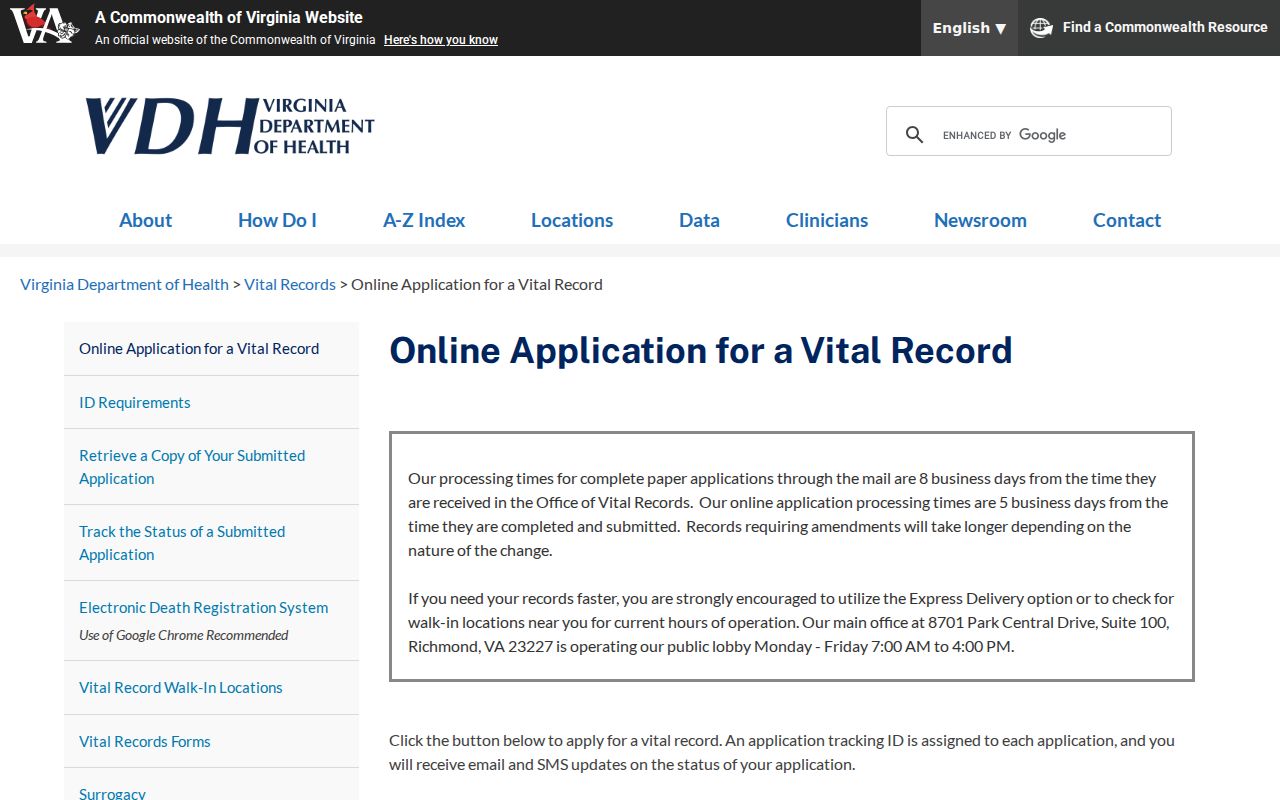
Vital records can confirm an event or a relationship, provided the statutory access period and the requester's eligibility allow it.
Arlington VFOIA Record Requests
Some Arlington County records never make it online. That is where the Virginia Freedom of Information Act comes in. A VFOIA request goes to the office that actually holds the record. It must describe what you want with reasonable specificity. Va. Code §2.2-3704 gives the public body five working days to respond. It can hand over the records, or cite a legal reason to withhold them. It can say none exist, or point you to the right custodian. The office may also explain that more time is needed. A timely extension can add seven work days.
Know the limits, though. VFOIA cannot force Arlington County to build a residents directory. It cannot answer a general research question for you. Records sealed by voter, vital, court, juvenile, medical, adoption, or other confidentiality laws stay closed. Charges for access, search, duplication, and supply may apply. A deposit can be requested when expected costs exceed $200. If your scope is unclear, ask for a cost estimate first.
Arlington’s 1935 Street Bridge
Address hunts in old Arlington often stall for a simple reason. Street names and numbers were reworked in 1935 under a system adopted the year before. The Community Archives keeps the Arlington County Virginia Directory of Street Names from 1935, which maps old labels onto new ones. Numbering has quirks too. The County ZIP map shows even numbers on the South and West sides of numbered streets. Directional prefixes and suffixes carry real weight when you line up an old address against a current parcel.
Jurisdiction changed as well. A record might read Alexandria County, Virginia. Another might say Alexandria County, District of Columbia. A third just says Arlington County. The Library of Virginia dates the District of Columbia period from 1801 to 1846 and the Arlington County renaming to 1920. Search every historical county name and both address forms before concluding a person or property vanished.
One more bridge exists at human scale. The County's local-history collections include a 1920 project that fills gaps in census schedules with death certificates, World War I enlistment forms, and 1910 and 1930 census material where a schedule was illegible or missing.
Historical Arlington Resident Directories
No single continuous run covers Arlington's historic directories. They sit scattered across repositories. Nelson's Directories run from 1912 through 1931 at Washingtoniana. Hill's Alexandria Directories cover 1938 through 1955 there. The Charlie Clark Center for Local History holds Hill's and Polk's volumes from 1924 through 1976. Haines Arlington issues run from 1976 through 1990. Older county, telephone, and real-estate directories fill in other years and formats.
What a directory can do depends on the volume. It may tie a person to an address, an occupation, a spouse, or a street listing. It cannot by itself settle ownership, full household membership, or a later move. The Charlie Clark Center sits at Central Library. Its reference material is used by appointment. The full shelf-by-shelf method is laid out in the Arlington City Directory.
Requesting off-site Community Archives material takes preparation. Note the collection, box, series, file number, and title from the finding aid first. The County says retrieval can take a week. Patron notification comes within seven business days once material is ready.
Arlington Community History Sources
Property rolls are not the whole story. The Charlie Clark Center for Local History keeps roughly 350 Arlington school yearbooks. It also holds local census microfilm, newspapers, maps, oral histories, photographs, family histories, and subject files. The Arlington Community Archives adds personal papers and organizational records. Together they can anchor a former resident to a school, a civic group, or a dated neighborhood event. They do not pretend to know a current address.
The oral-history program dates to the 1970s. Its published description counts 575 catalogued interviews. Digitized newspaper holdings span 1935 through 1978. They include the Columbia News, Daily Sun, Northern Virginia Sun, and Sun. These sources shine once a parcel or directory gives you a date and address, whether you are tracing relatives, classmates, or neighborhood history.
Note: A yearbook, newspaper, or oral-history mention proves only what that item itself says, so keep its date and collection citation.
Arlington Custody and License Searches
Not every public system answers a residence question. Some answer a narrower one. The Arlington Sheriff's Inmate Query filters by name, subject number, booking number, custody status, booking-date range, and facility. Results display a photo, name, and subject number. A custody listing is informational. It does not establish guilt, a full legal status, or a home address. State and federal custody systems follow their own separate search rules.
The Arlington Sheriff Inmate Query shows the fields and result-table layout behind this narrow record type.
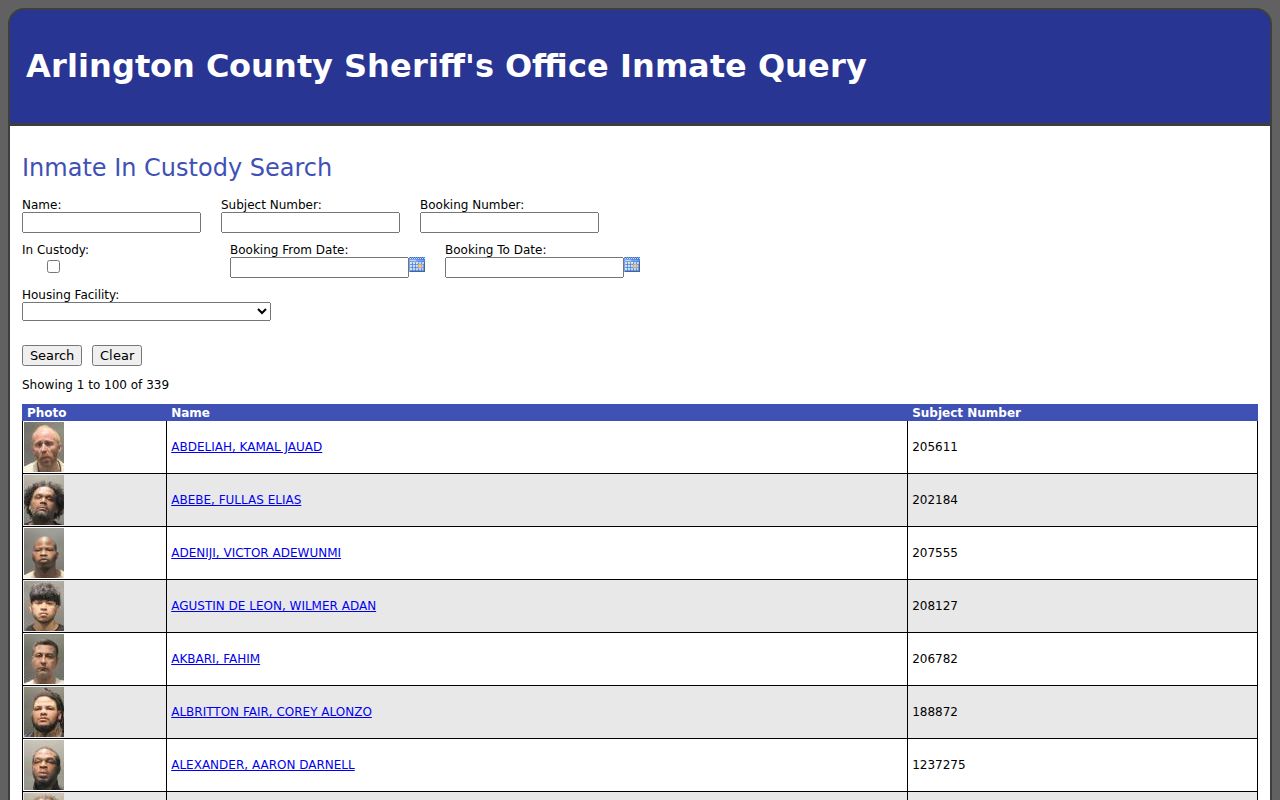
Treat a custody result as a status report only. Verify later court developments with the proper court record.
Virginia DPOR's license lookup works as a separate affiliation source. It offers a basic search field plus advanced search. The agency cautions that its web data is not its formal public record. A professional or business address proves nothing about where a licensee lives. It may only show where they work.
The Virginia DPOR License Lookup screen illustrates this official convenience-search route.
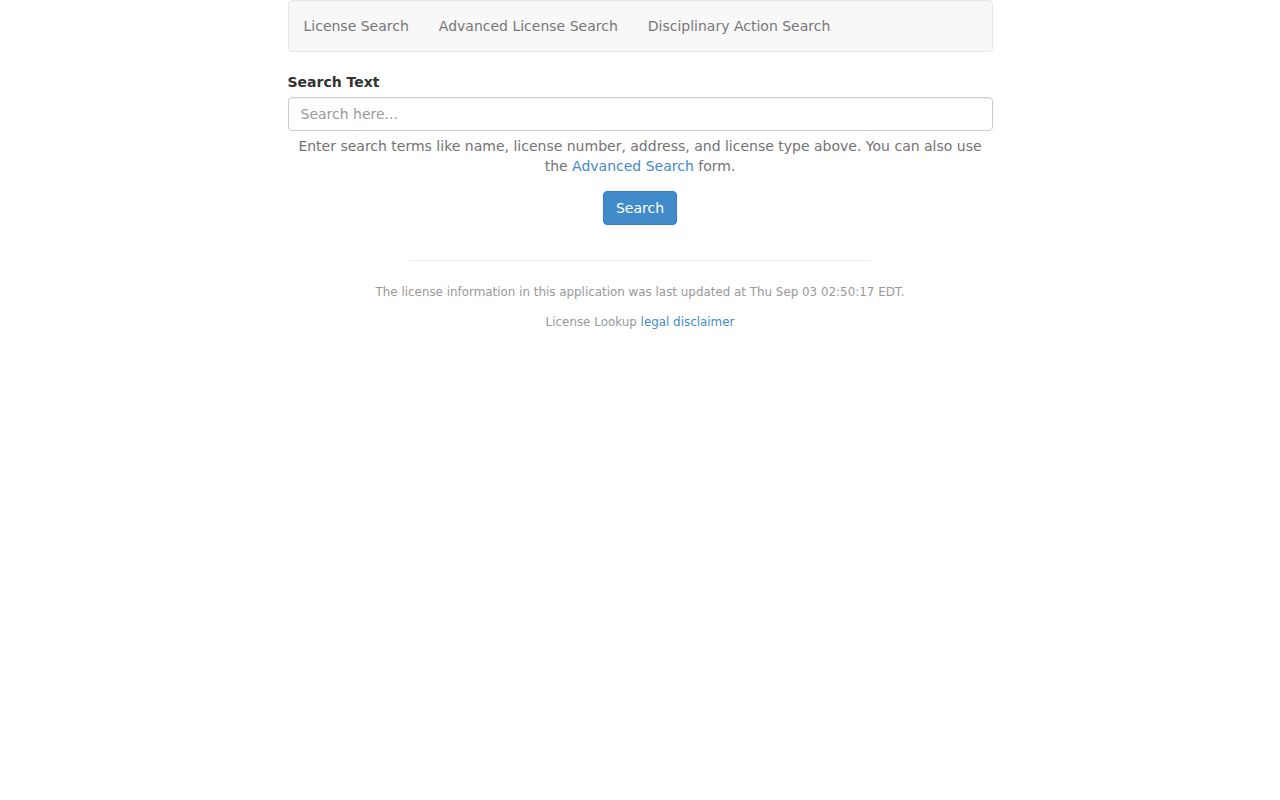
Check any license result with the issuing agency whenever a current professional status or formal record matters.
Arlington Scam-Safe Record Checks
Scammers love public records because real details make a story convincing. Arlington Police issued a warning in July 2025. Callers could falsify caller ID and pose as police demanding money. An October 2025 warning added outstanding-warrant and jury-duty demands along with property-improvement scams. The County and Sheriff never call, text, or email to collect fines.
Hang up on the unsolicited call. Then dial a number the agency has already published. Arlington directs police-impersonation concerns to 703-558-2222. A deed-copy letter deserves the same caution. Compare it against the Circuit Court's published fees and phone number. Never use the number printed on the solicitation. A record search is safest when its source, date, and custodian can each be checked.