
Arlington Previous Residents Sources
An Arlington address has several time layers. The property card supplies the current RPC, legal description, map book and page, and sales identifiers. The deed trail then follows the land from one named party to the next. Directories and census schedules can help identify past residents, but they answer a different question from a deed. A directory entry is a dated clue about a person at an address; it does not replace the recorded chain of title. Start with the source nearest the period you need and keep the property description beside every name.
| Arlington source | Period available | Where to use it | Address evidence |
|---|---|---|---|
| Official Records Search | Remote access through 1869 | Circuit Court index, kiosk, counter, or mail | Recorded deeds, mortgages, parties, and legal descriptions |
| Library of Virginia deed material | 1800 to 1869 indexes and books, plus later listed ranges | Library of Virginia microfilm | Earlier Alexandria County deed-chain evidence |
| Local directory runs | 1912 to 1990 across overlapping runs | Washingtoniana and CCCLH | Names, addresses, spouse and other dated clues |
| Federal census and local 1920 project | Released federal schedules; local 1920 supplements | CCCLH, NARA, and archive services | Household and enumeration-district context |
| Maps, aerials, and permits | Aerials 1934 to 1989; permit start date not located | County resources and Permit Office kiosk | Building changes, parcel context, and work chronology |
The Circuit Court Land Records Division offers a registered online index, a free public kiosk, counter access, and limited mail copies when the book and page are known. The mail route is limited to five documents and needs a self-addressed stamped envelope and check. Older volumes can require the Library of Virginia. The Charlie Clark Center for Local History, known as CCCLH, is the practical stop for directory, map, newspaper, and census context. Its reference material is used in the reading room rather than checked out.
Note: An owner name or a tax mailing address is a lead, not proof that the named person lived at the property.
Arlington Previous Residents and Deeds
For previous residents research, deeds are the durable start because the County historic-property method tells researchers to use the legal property description and work backward from the current deed. Arlington Property Search shows the current parcel facts, owner, mailing address, sales tab, deed book and page, and document identifiers. The sales result is the bridge to a recorded instrument, not a finding about who was physically present at the address. Remote index access reaches through 1869, while the older paper and microfilm trail reaches farther into the Alexandria County era.
Use the Arlington Official Records Search after creating the required registered account. Index viewing is free. Remote images cost $0.50 per page plus a $2 transaction fee for a nonsubscriber, while a Secure Remote Access subscription is listed at $50 per month or $600 per year. A courthouse kiosk is free and staff can give general guidance, although they do not conduct the research.
The Official Records Search is shown below at its registration and index-access screen.
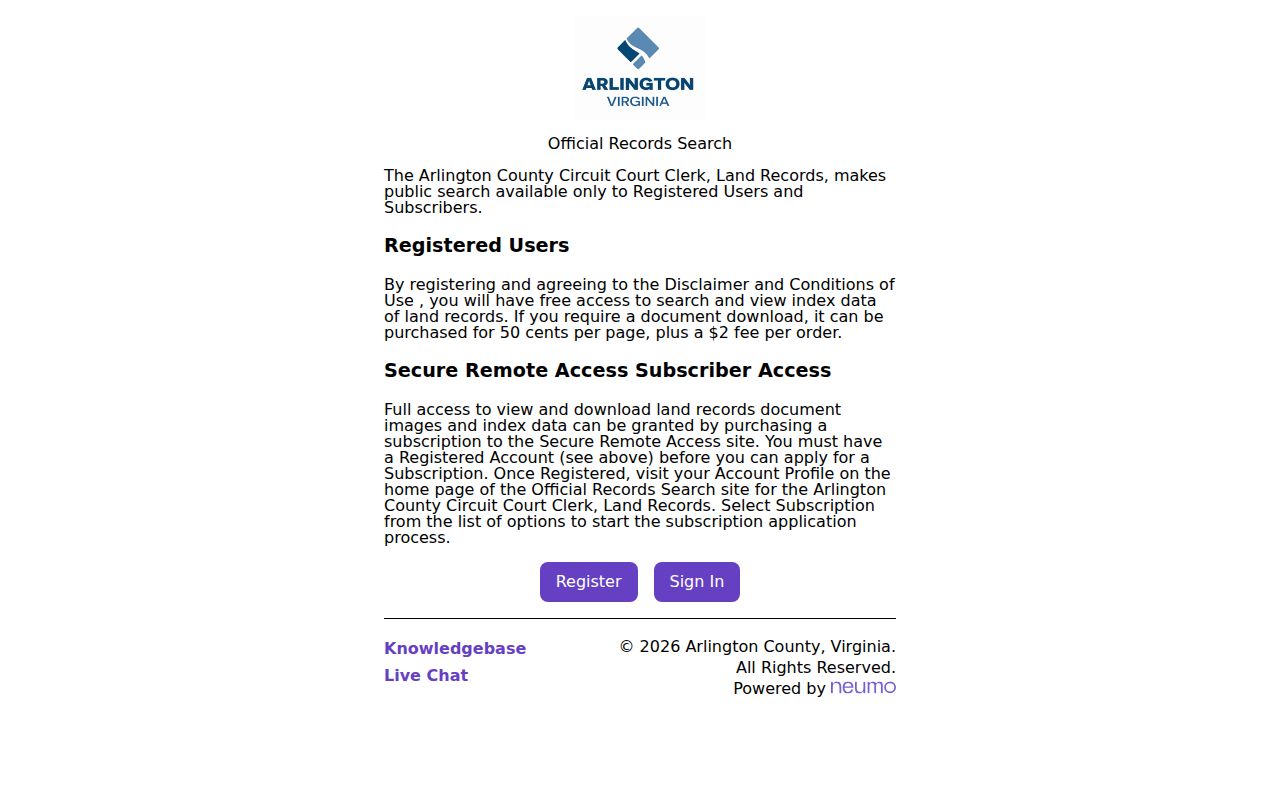
That access screen is a useful reminder to plan for the index, a paid image, the free kiosk, or a mail request before a chain reaches a missing document.
- Copy the current RPC, owner, mailing address, legal description, map book and page, and sales-history document IDs from Property Search.
- Find the current purchase in the land-record index. Transcribe the grantor, grantee, recording date, consideration, and legal description from the deed.
- Search the prior grantor as a grantee, then match the subdivision, lot, or condominium unit to avoid following a different parcel.
- Repeat one transfer at a time. If an instrument involves an estate, trust, will, or gift, check the probate record for the fiduciary or heir named there.
- Move to a kiosk, deed books, microfilm, or the limited mail process when online access no longer supplies the needed image.
- Grantor / grantee
- The grantor transfers an interest in a recorded document; the grantee receives that interest.
- Chain of title
- A chronological line of recorded transfers for one parcel or legal description.
- Legal description
- The lot, subdivision, unit, or other land description used in the record. It keeps the trail together when an address changes.
- RPC
- The County real-property code used to identify the parcel in Arlington Property Search.
Note: Finding a former seller as a later grantee may suggest another property trail, but it does not establish that person’s current location.
Arlington Sales Records Bridge
Property Search has a sales tab that can list a grantee, sale date, sale price, sale code, deed book and page, and deed document ID. Those fields make a careful handoff from an assessor record to land records. Copy the identifiers exactly. A sales row can include a transfer by a trust or entity, so names must remain tied to the instrument and parcel rather than treated as a list of past residents.
The County’s Property Search sales-history result illustrates the deed identifiers available in the public result.
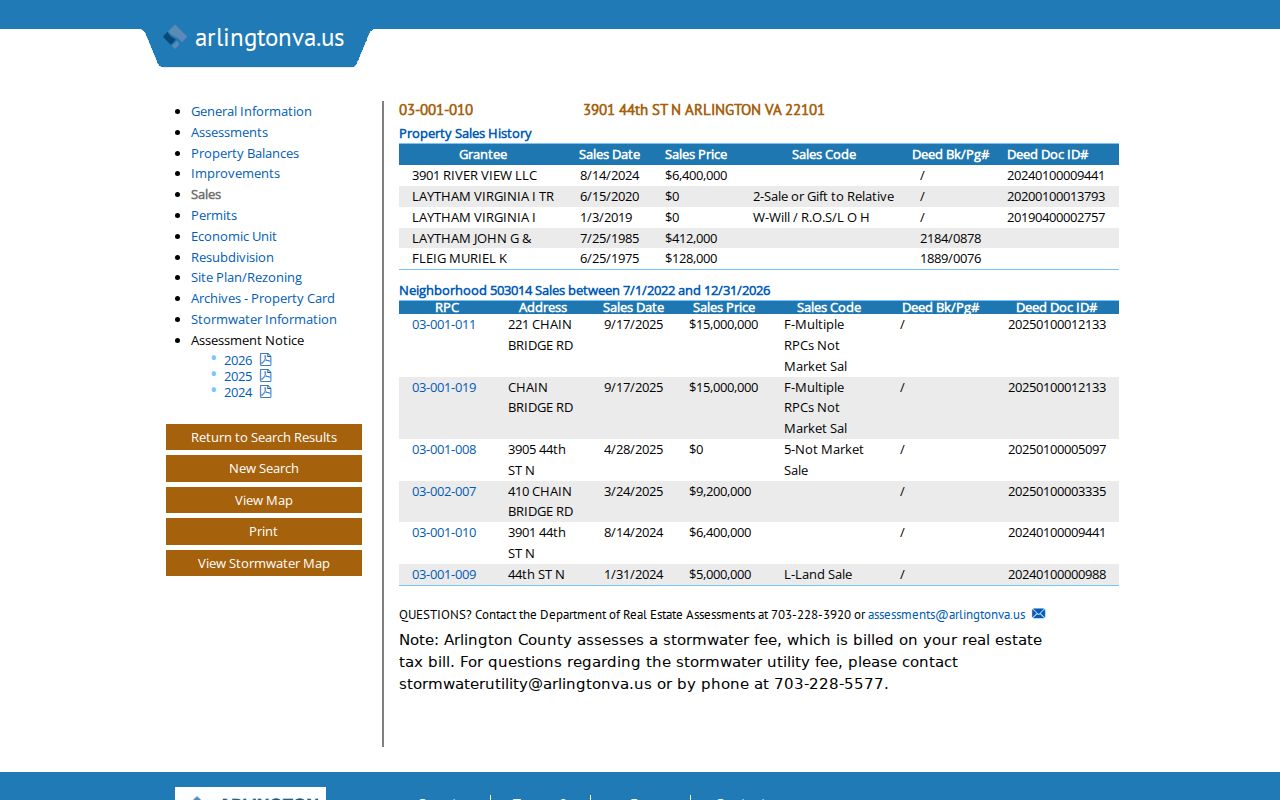
Use a deed book and page or document ID from that result to request the actual instrument, then compare its legal description before adding it to a house-history timeline.
When an instrument reaches a will, estate, trust, or deed of gift, use the Circuit Court Probate Office as a related record source. Probate is computerized from 1997 forward, has images after 2000, and has public kiosk indexes for 1800 through 1996. The named fiduciary or heir can explain why the next recorded transfer does not look like an ordinary sale.
Arlington Previous Residents Address Change
Arlington’s original street names and numbers changed in 1935, after a new street-name system was adopted in 1934. That conversion can make a perfectly correct old directory entry invisible to a modern address search. Record both forms of the address, then use the lot, legal description, plat, 1900 property-owner map, or aerial evidence to test whether the two forms point to the same parcel.
Jurisdiction names need the same care. Before 1920, an Arlington ancestor may appear under Alexandria County. From 1801 through 1846, the Library of Virginia catalog uses Alexandria County, District of Columbia; it returns to Alexandria County, Virginia through 1920. The 1935 street-name directory and the historical county name are both search keys, not incidental background.
Note: A current street number alone can skip a valid older record when the old directory used a different name or numbering system.
Arlington Previous Residents in Directories
Once the deed timeline supplies a period and a legal address, use the directory layer to look for who lived here before. Nelson’s runs cover 1912 to 1931 at Washingtoniana. Hill’s Alexandria runs cover 1938 to 1955 there, Hill’s and Polk’s cover 1924 to 1976 at CCCLH, and Haines Arlington covers 1976 to 1990 at CCCLH. These collections overlap and are not one continuous online series. The holdings and entry-reading details belong with the Arlington city directory collections; the address trail uses them as dated household evidence.
Some volumes may contain a street section or reverse material, but the public source does not identify a complete local criss-cross title and run. Ask CCCLH staff for the call number and confirm the volume’s own abbreviations. The Center is at Central Library, and its local-history room is available by appointment. Its off-site Community Archives material requires a request and about a week for retrieval, with notification within seven business days.
- Choose the directory volume nearest the transfer or known family date and search both the name and any street section.
- Write down the address form, spouse notation, and every change in name, address, or household clue without converting it into a deed fact.
- Pair the result with the closest released federal census year and the local 1920 project when the period fits.
- Use newspaper, yearbook, or obituary material to corroborate a move, death, school connection, or organization.
The County’s 1920 project adds detailed datasheets, surname rankings, five local enumeration districts, and supplements from death certificates, World War I enlistment forms, and 1910 and 1930 census material when the schedule was hard to read. That makes it especially useful when a directory clue needs a household context.
Arlington House History Maps
Maps and construction records test whether an address trail belongs to the same physical place. The County historic-property route points to Franklin Survey Company real-estate atlases from 1930 to 1942, 1942 to 1948, and 1952 to 1965; a 1900 property-owner map; and historic aerial photography from 1934 to 1989. CCCLH and Historic Preservation add Sanborn maps, local maps, photos, and digital historic-district material. A map can show a building footprint or subdivision context, but it is not a legal substitute for a recorded plat.
Open the Arlington Historical Society property-history resource before choosing an archive or map repository.
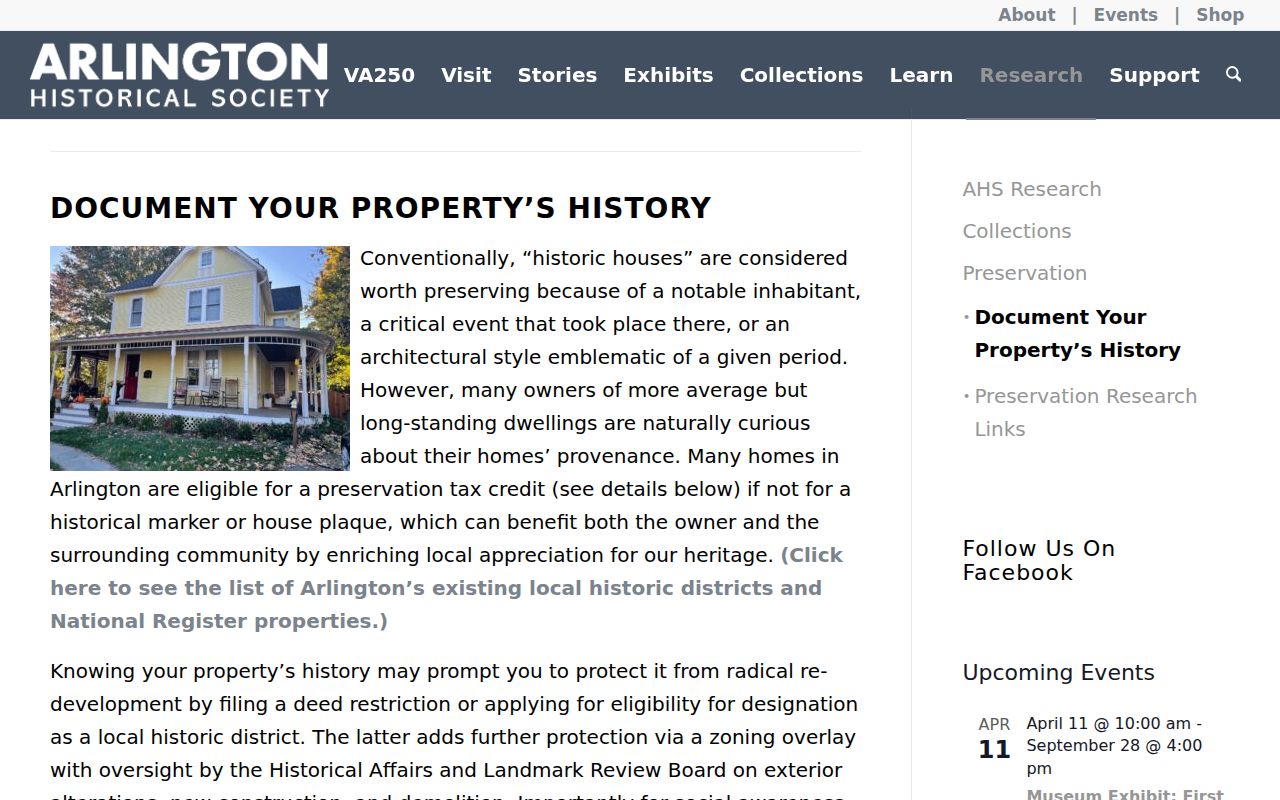
That property-history route brings deeds, directories, maps, tax records, newspapers, and archive material together without treating any single one as a complete answer.
Permit Arlington adds another date layer. Its research kiosk can search by address, permit number, or RPC and open permits, inspections, plats, plans, conditions, and letters. Save kiosk documents to your own USB because the kiosk does not email or print. The public research does not establish a start year for historic permits, so do not assume a missing online permit means no older work occurred.
Arlington Past Residents and Probate
Probate and obituary evidence can close gaps that deeds leave open. A death notice may name a spouse, children, funeral home, church, or last address. A probate file can connect a decedent with an executor, heir, property, and a later transfer. Arlington Circuit Court Probate has computerized records from 1997 forward, images after 2000, and kiosk indexes for 1800 through 1996; use the probate office, kiosk, or STARR access as the time period requires.
The difference matters. A deed may show that property transferred from an estate, while a directory might place a person at the address in a particular year. Neither source proves more than its own record states. Keep record dates in sequence and use the source that actually establishes the claimed relationship or event.
Lawful use. Arlington house-history and family-history research must not be used to follow, threaten, expose, or harass a living person. Virginia stalking law, Va. Code §18.2-60.3, can apply to repeated conduct that creates the specified fear of harm.
Arlington Previous Residents Before 1920
Older Arlington records require the name of the jurisdiction that existed when the record was made. The Library of Virginia lists Alexandria County, Virginia from 1789 to 1801; Alexandria County, District of Columbia from 1801 to 1846; and Alexandria County, Virginia from 1846 to 1920. Arlington County was renamed in 1920. Search those forms alongside Arlington when the date falls near a transition.
The Library of Virginia catalog identifies a general index to Deeds O for 1800 to 1869, deed books 1 through 8 spanning 1801 to 1865, and later book ranges. Some reels cannot be borrowed through interlibrary loan. This overlap with Arlington’s remote land-record coverage gives a practical fallback when a previous residents trail moves before the online period. The older material should be matched by legal description and deed references, not guessed from a current street label.